



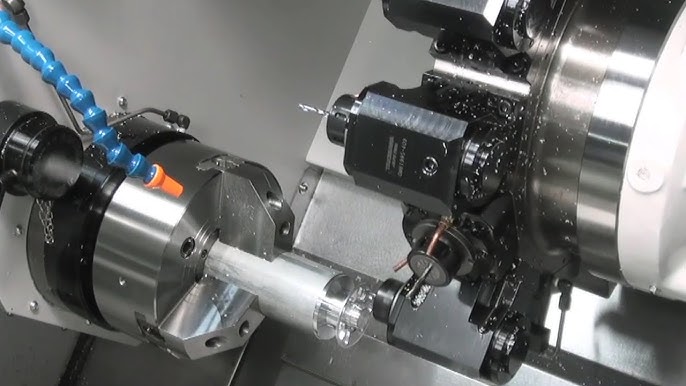
The manufacturing industry is continuously evolving, driven by innovations in automation, precision engineering, and digital technology. One area that has seen significant advancements is the 2 axis CNC lathe system, a machine widely used for turning operations and cylindrical component production. These lathes, which traditionally focused on basic rotational machining along X and Z axes, have been upgraded with new technologies that improve efficiency, precision, and versatility. Understanding these developments is essential for manufacturers seeking to optimize production and remain competitive in modern industrial environments.
Recent innovations in the 2 Axis CNC Lathe industry have focused on improving machine accuracy, reducing production time, and integrating advanced digital controls. Modern systems now incorporate high-precision ball screws, linear guideways, and advanced spindle technology, allowing for smoother operation and higher machining accuracy. Additionally, developments in CNC controllers and software have introduced user-friendly interfaces, adaptive programming, and real-time monitoring, making it easier for operators to produce complex components efficiently. These enhancements are helping businesses achieve higher quality standards while minimizing waste and production costs.
High-Precision Components and Advanced Spindle Technology
One of the most notable developments in 2 axis CNC lathe systems is the incorporation of high-precision components. Modern ball screws and linear guideways reduce mechanical backlash, which directly enhances dimensional accuracy and repeatability. This is especially important for industries such as automotive and aerospace, where even minor deviations can affect the performance of critical parts.
Spindle technology has also evolved, with improvements in rigidity, speed control, and thermal stability. High-performance spindles now allow faster rotation speeds without compromising accuracy, which increases throughput while maintaining precise tolerances. Additionally, new spindle designs reduce vibration, resulting in smoother surface finishes and extended tool life.
Smart CNC Controllers and Software Integration
Controller technology has been another area of rapid advancement in 2 axis CNC lathe systems. Modern CNC controllers are equipped with high-resolution displays, touch interfaces, and integrated help functions that simplify machine operation. These controllers often include adaptive features such as automatic feed rate adjustment based on cutting conditions, predictive maintenance alerts, and remote monitoring capabilities.
Software improvements have also enhanced programming efficiency. Advanced CAD/CAM integration allows operators to generate tool paths and simulate machining processes before actual production. This reduces errors, shortens setup times, and ensures consistency in batch production. Cloud connectivity and IoT integration in some modern systems enable centralized monitoring of multiple machines, optimizing resource allocation and production planning.
Automation and Efficiency Enhancements
Automation has become a key focus in modern 2 axis CNC lathe systems. While traditional lathes required manual loading and unloading of materials, newer systems now support robotic automation for part handling, reducing downtime and labor costs. Automated tool changers allow multiple machining operations to be performed in sequence without manual intervention, further improving operational efficiency.
Energy efficiency has also improved with the introduction of variable frequency drives and intelligent power management systems. These features optimize energy consumption during idle periods and reduce operational costs, making modern 2 axis CNC lathes more environmentally sustainable.
Safety and Ergonomic Improvements
Safety standards and operator ergonomics have been a major consideration in the latest 2 axis CNC lathe developments. Modern machines often include fully enclosed work zones with interlocking doors to prevent accidental contact with moving parts. Noise reduction measures, improved lighting, and better control panel placement contribute to a safer and more comfortable working environment.
In addition, advanced monitoring systems can detect abnormal vibrations, tool wear, or potential collisions, automatically pausing operations to prevent damage to the workpiece or machine. These safety innovations not only protect operators but also reduce costly downtime caused by machine failures.
Industrial Applications of Modern 2 Axis CNC Lathes
The technological advancements in 2 axis CNC lathe systems have expanded their applications across multiple industries. Automotive manufacturers use these machines to produce precision shafts, bushings, and engine components. Aerospace companies rely on them for high-tolerance cylindrical parts that must meet strict quality standards. Other industries, such as electronics, medical device manufacturing, and general metalworking, benefit from the improved accuracy, speed, and reliability of modern lathes.
The combination of automation, advanced spindle technology, and integrated software solutions allows manufacturers to produce high-quality parts in shorter cycles, reduce material waste, and achieve better overall productivity. This makes the modern 2 axis CNC lathe an essential tool for competitive manufacturing operations.
Conclusion
The latest technological developments in 2 axis CNC lathe systems have significantly enhanced their precision, efficiency, and versatility. High-precision components, advanced spindle designs, intelligent CNC controllers, automation features, and improved safety measures have transformed traditional lathes into powerful tools capable of meeting modern industrial demands. These advancements make it possible for manufacturers to produce high-quality cylindrical components more efficiently and consistently, reinforcing the 2 axis CNC lathe as a key player in contemporary manufacturing processes. By adopting these innovations, industries can maintain competitiveness while achieving higher standards of precision, reliability, and operational efficiency.